10 Behind-the-Scenes Movie Secrets That Audiences Rarely Notice
Movies can make impossible events feel believable. From dangerous stunts and dramatic explosions to emotional performances and breathtaking locations, filmmakers use countless techniques to bring stories to life. While audiences focus on the characters and plot, much of the real work happens behind the camera.
Here are ten fascinating behind-the-scenes movie secrets that audiences rarely notice.
Movie Rain Is Often Artificial
Rainy scenes can make a movie feel emotional, mysterious, or dramatic. However, filmmakers rarely depend entirely on natural weather when shooting important scenes.
Production teams often use specialized rain machines to create controlled rainfall. These systems allow directors to decide where the rain falls, how heavy it appears, and how it interacts with the actors and surroundings.
Lighting also plays an important role. Water droplets become more visible when illuminated from certain angles, making artificial rain look convincing on camera.
Green Screens Can Create Entire Worlds
Fantasy, science fiction, and superhero movies frequently feature places that do not exist in reality. These environments may include alien planets, futuristic cities, underwater kingdoms, or enormous imaginary landscapes.
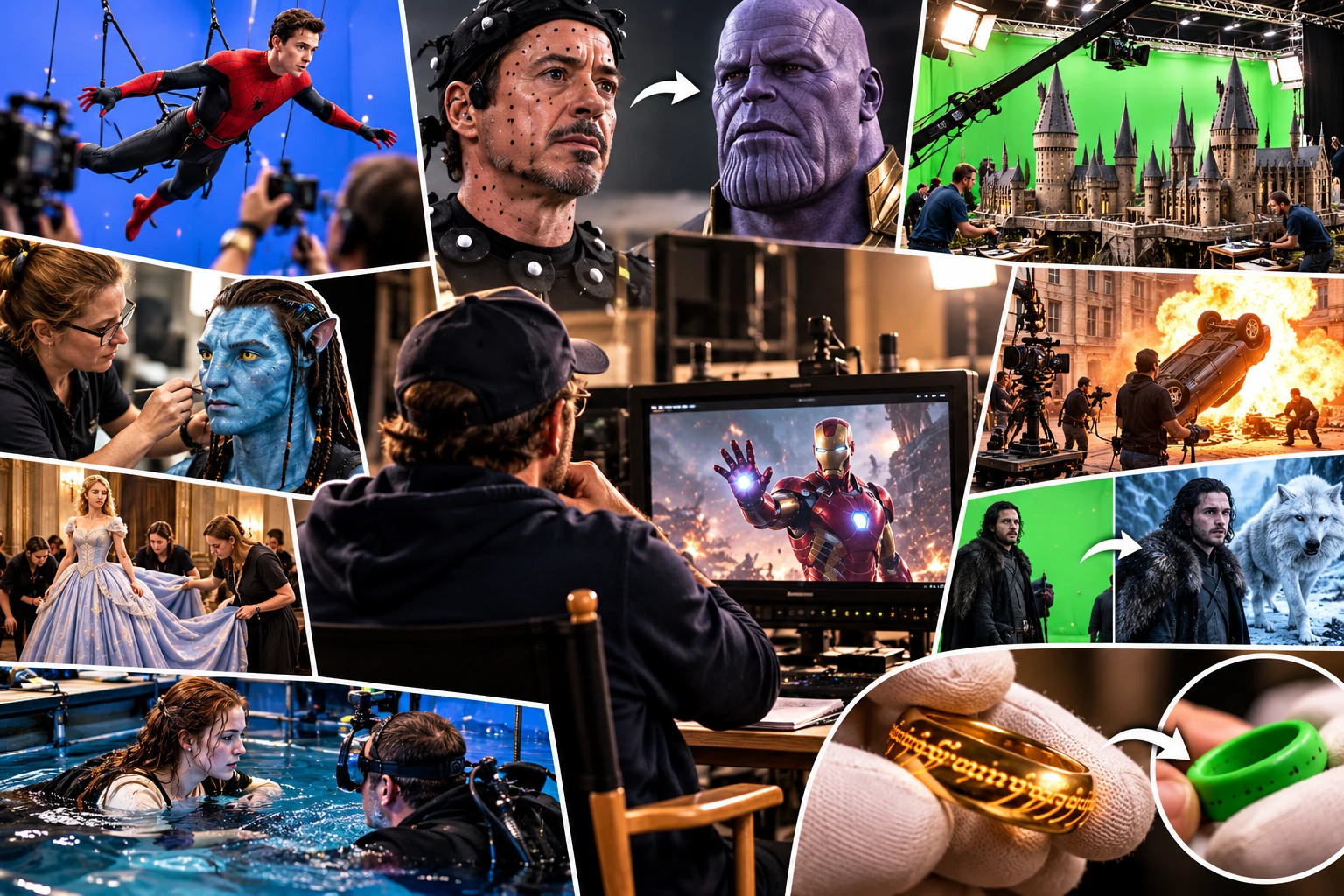
Green screens allow filmmakers to combine live-action footage with digitally created backgrounds. Actors perform in front of a colored backdrop, and visual effects artists later replace that background with the desired environment.
Green is commonly used because it contrasts with many skin tones and can be separated digitally. Blue screens are also used when they suit the scene better.
Movie Food Is Not Always What It Appears to Be
Food scenes seem simple, but they can create unexpected challenges during filming. Actors may need to repeat the same action dozens of times, including eating, drinking, or serving a meal.
If a scene requires an actor to take repeated bites, the production team must prepare enough food for multiple takes. Continuity becomes difficult when plates become emptier with every shot.
Some productions use substitutes for specific foods or drinks when practical. Unsweetened beverages, carefully prepared food props, or other alternatives may be used depending on the scene.
Sound Effects Are Created Using Unexpected Objects
Movies contain thousands of sounds, including footsteps, breaking glass, animal noises, doors opening, and objects crashing into the ground.
Surprisingly, the sounds heard in a movie do not always come from the objects shown on screen. Sound designers often create or record effects separately in a process known as Foley.
For example, footsteps on snow might be recreated by squeezing or crushing suitable materials. A heavy door may be represented by manipulating another object that produces the right sound.
Actors Often Perform Scenes Out of Order
Audiences experience a movie as a continuous story, but filming usually follows a different sequence.
Production schedules depend on locations, actor availability, lighting requirements, set construction, and budget. As a result, a scene set near the end of the story might be filmed before an earlier scene.
Actors must remember the emotional state of their characters at different points in the plot. They may need to portray sadness in one shot and happiness in another, even if those moments occur days apart during production.
Movie Sets Can Be Much Smaller Than They Look
A grand palace, crowded street, or enormous building may appear impressive on screen, but the physical set might occupy only a small space.
Filmmakers use camera angles, perspective, lighting, and carefully arranged props to create the illusion of size. Sometimes, only the part of a location visible to the camera is constructed.
Digital extensions can add towers, distant buildings, landscapes, or crowds beyond the physical set.
Lighting Can Completely Change an Actor’s Appearance
Lighting is one of the most powerful tools in filmmaking. It influences the atmosphere of a scene and affects how audiences perceive the characters.
Soft lighting can create a gentle, flattering appearance, while harsh shadows may suggest danger, tension, or mystery. Colored lights can make a setting feel cold, warm, romantic, or unsettling.
Cinematographers carefully position lights, reflectors, and other equipment to control shadows and highlights.
Many Movie Stunts Use Safety Equipment
Action movies feature dramatic falls, vehicle chases, fights, and explosions. Although the finished scenes may look dangerous, professional stunt teams use carefully planned techniques to reduce risks.
Stunt performers train to execute specific movements, while coordinators plan timing, camera placement, and safety procedures. Harnesses, crash mats, protective equipment, and controlled environments may be used depending on the stunt.
Editing can combine several shots to create one continuous action sequence. A brief moment of danger on screen may require hours of preparation and multiple rehearsals.
Background Actors Help Create Realistic Worlds
A busy airport, wedding celebration, school corridor, or city street needs more than its main characters to feel believable.
Background performers, often called extras, help create the impression that the world continues beyond the central story.
They may be given specific movements and instructions to avoid distractions. For example, performers in a restaurant scene might be asked to appear engaged in conversation without drawing attention away from the lead actors.
Editing Can Transform an Entire Performance
Editing is not simply about joining scenes together. It determines pacing, suspense, emotional emphasis, and the information audiences receive.
A reaction shot can make a conversation feel more emotional. A quick sequence of cuts can make an action scene feel faster, while longer shots may create tension or allow a performance to breathe.
Editors often review multiple takes to find the most effective expressions, movements, and dialogue deliveries. They may combine different takes to create a polished sequence.